Why White-Label BaaS Is the Key to Financial Innovation
Embedded finance — the integration of banking and financial services into a range of digital services — is a soaring market right now. This surge of financial innovation comes in the wake of shifting consumer habits and subsequent business requirements. Consumers want businesses to meet them wherever they are, whether on their smartphones or work laptops. Consequently, businesses must find ways to provide financial solutions across various devices.
Yet, not every firm has an in-house app developer or financial expert. Hiring these specialists can be costly yet without that expertise, the complexity of creating financially connected apps and services means that the time-to-market is excessive. While consumers wait for the services they expect, their satisfaction drops, and they may head to a competitor who is easier to deal with.
White-label financial solutions can provide a pathway to success for businesses struggling with these challenges. Banking-as-a-Service (BaaS) is a relatively new offering, connecting experts in digital financial solutions with the banks and businesses that need them. White-label BaaS could revolutionize banking service creation via scalable, cost-effective, and customizable financial solutions.
What is White-label BaaS?
White-label products and services are created for companies by a third party that specializes in that type of service [2]. It's a common practice when companies need a particular product (physical or digital) but don't have the means to produce it themselves, or the cost/time to produce it "in-house" would be too high. Importantly, white-label services allow the company to put its own branding on the service.
BaaS platforms enable companies to embed financial services into their apps, websites, and other digital products. For example, an e-commerce site may utilize BaaS to provide them with a secure payment solution. BaaS can also be used by banks and other financial institutions, for example, if a bank wants to expand its digital offerings but doesn’t have the technical know-how to set this up.
A white-label banking platform customizes banking services for a company, which can then brand these services as its own.
BaaS platforms are generally API-driven financial services. Existing company systems and applications utilize APIs to connect to and integrate with the relevant banking services.
Real-world examples of white-label solutions for embedded finance include incumbent banks like NatWest and HSBC, which now leverage their existing systems to provide chargeable BaaS offerings to other financial institutions. FinTech startups may utilize BaaS platforms as the underlying tech stack for their innovation. Aside from financial institutions, many businesses also use BaaS to ensure they have secure ways for consumers to order and pay for goods.
The Need for Financial Innovation
Traditional banking is no longer the norm for most businesses and consumers. Conventional financial systems are slow, costly to integrate, and inaccessible for many smaller businesses and entrepreneurs.
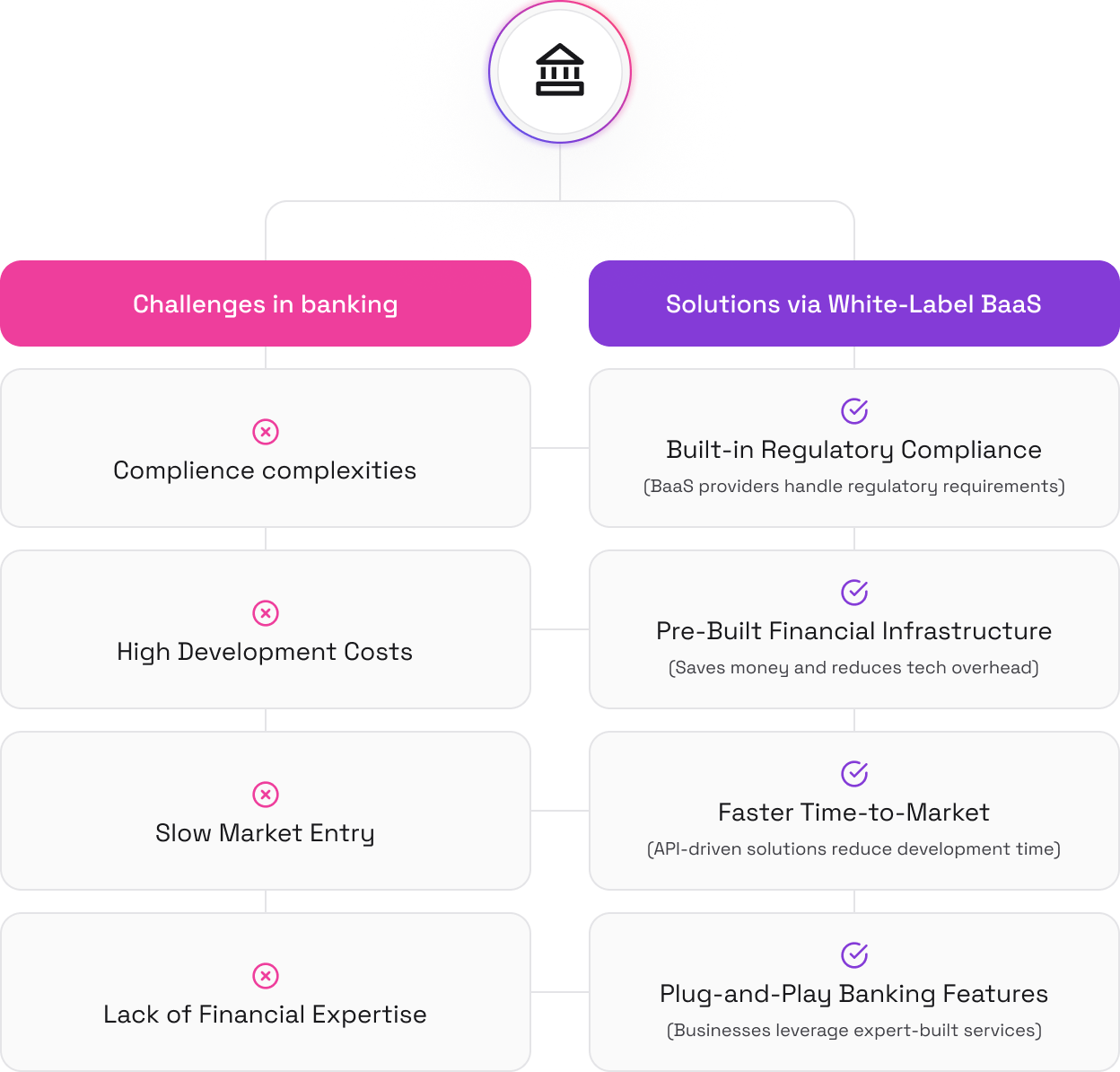
Conversely, consumers want fast solutions for all their needs, from the ability to instantly pay for an item to the desire to make instant decisions on credit card and loan applications. “Pay Later” credit services are also becoming the norm, with online retailers and service providers now having to offer more ways to pay than ever before. [3]
Businesses and banks that can’t meet these changing expectations are likely to be left behind. Successful competitors focus on providing versatile, efficient services for their users — an attitude that demands constant innovation.
How White-label BaaS Drives Financial Innovation
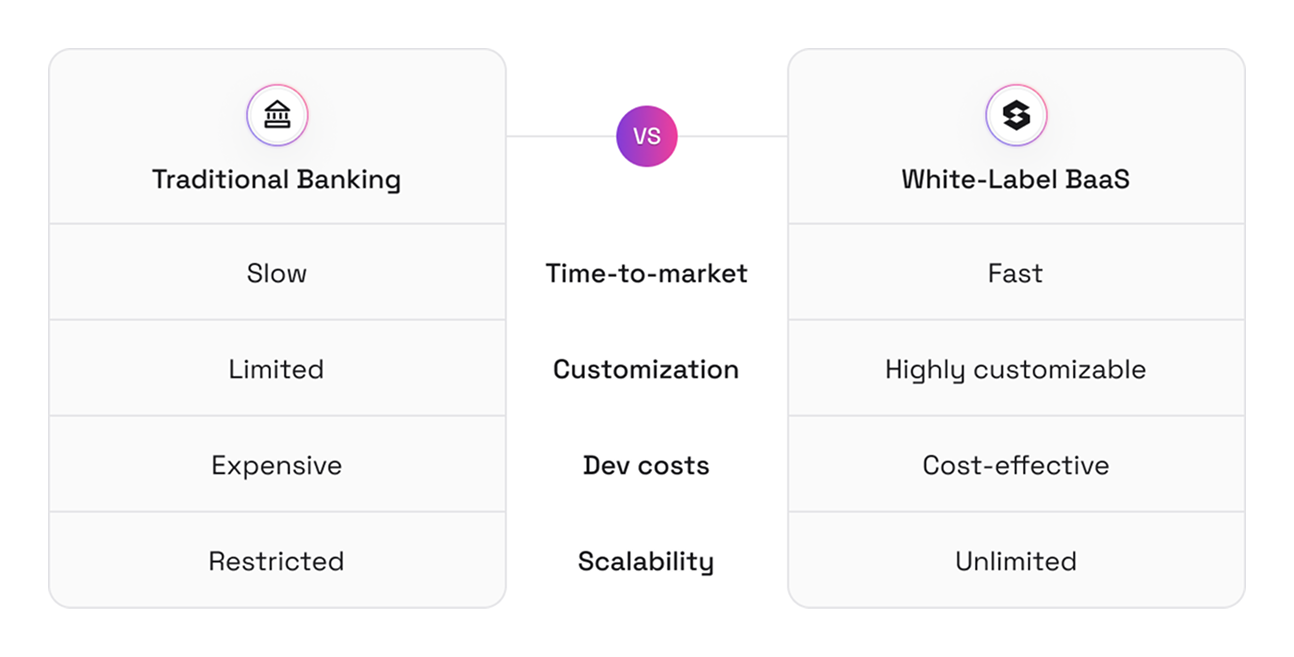
BaaS platform benefits range from the maximized potential for increased ROI to unlimited scalability. Businesses can save thousands of dollars by cutting out the requirement to build an entire financial infrastructure from scratch.
Along with increased cost-effectiveness, time is another commodity businesses save by leveraging the expertise of third-party financial providers to reduce time-to-market.
One of the most appealing benefits of white-label BaaS platforms for growing businesses is scalability. Because the services are customized, the platform can grow with the business, adding new features as needed. For example, a neobank focused on consumer finance may utilize a scalable BaaS platform to expand into wealth management.
On that note, the ability to fully customize financial services is a primary benefit of cost-effective BaaS platforms. The best BaaS provider should be able to help firms create fully branded user interfaces or bespoke white-label FinTech solutions.
Real-World Use Cases: What Firms Do with BaaS
Let’s take a look at a few real-world examples of white-label BaaS. FinTech startups are some of the organizations most likely to benefit from innovative BaaS. For example, a digital investment organization recently expanded its offerings to include an embedded savings account, thanks to its collaboration with a BaaS provider. [4]

Gig workers need apps to conduct all aspects of their business. Those apps should include ways for clients to pay and for freelancers to instantly access those payments.
One of the most common embedded financial services use cases is the growing business wanting to offer branded financial products to its customers. A store-branded credit card, for example, is usually only possible with a white-label banking solution.
The Role of APIs in White-Label BaaS
White-label BaaS platforms are driving innovation at all levels of the financial sector via an API-first approach. The ability to seamlessly integrate with existing financial infrastructures using APIs means that it’s easier than ever to get started with a BaaS provider.
APIs enable businesses to connect to multiple services, creating a unified ecosystem that contains as few or as many financial features as needed. The best BaaS providers offer developer-friendly documentation and continuous support, helping consistently drive innovation.
Challenges and How White-Label BaaS Solves Them
While innovation is exciting, compliance in BaaS platforms is essential. In 2024, scrutiny of banking apps increased, with several notable enforcement actions taken against financial providers. [6] BaaS providers are now more likely to perform due diligence, ensuring they cover every point of local, national, and international law that applies to their services. Companies that work with trusted BaaS providers are less likely to fall foul of regulatory complexities.
Businesses need to know that they can rely on their financial providers. The best white-label BaaS providers for startups and established businesses must demonstrate trustworthiness. The right vendor will demonstrate knowledge of their sector and quickly know how to address current challenges and plan for the future.
The Future of Financial Innovation and White-Label BaaS
That last point is what’s continually driving innovation in the BaaS industry — the need to anticipate and innovate for the next trends in financial services. AI-driven financial insights are a driving factor, with companies already utilizing AI for risk assessments and analytics. Blockchain and decentralized finance trends continue to expand, with interoperability between blockchains a possible focus for the coming years. Finally, BaaS represents opportunities for underserved markets to gain access to financial services that were previously unattainable, either due to prohibitive costs or because providers simply didn’t exist for niche industries.
Cost-effective BaaS platforms bridge the gap between financial institutions and non-financial businesses. Firms in all industries now have the opportunity to provide financial services to their users at a lower price point than ever before. However, BaaS platforms also create opportunities for growing FinTech startups. Robust banking platforms provide a jumping-off point for the most exciting financial innovators, utilizing a trusted foundation.
Conclusion: The Case for White-Label BaaS
White-label BaaS is about more than branding a pre-existing financial service. It’s about creating something that’s unique to your company, that carries your values and integrates with your core offerings. With the right BaaS provider, you can save money, get your services to market faster, and delight your rapidly expanding audience.
Ready to scale? See how Staq can help your business thrive.