The Complete Guide to Embedded Finance: From Strategy to Launch

Modern-day businesses face numerous challenges, including customer expectations for faster, more convenient financial transactions. It applies to a variety of scenarios, whether a customer requires credit at checkout or embedded insurance when making a purchase.
Transaction convenience has become crucial, enabling businesses to allocate more time to other meaningful tasks, such as product research. According to Juniper Research, the embedded finance market is projected to grow from $65 billion to $183 billion by 2027, representing a critical opportunity for strategic financial technology integration[1]. This highlights the importance of utilizing the right financial resources and systems in today's modern business.
Still, many companies today have outdated, redundant systems that offer little convenience during financial transactions. Embedded finance represents a transformative technological solution enabling organizations to modernize financial service delivery and enhance operational efficiency. It will support various resources, including credit scoring, insurance claim automation, digital wallets, and reconciliation procedures.
It also improves companies' revenue performance, as customers can make more purchases more conveniently. Implementing these systems requires experts for the best results. This guide identifies all you need to know.
Assessing Embedded Finance Readiness for Your Organization
Your first step in using this business approach is to determine whether it suits your business's operations.
Recognize that not every company needs to offer financial solutions, such as embedded finance. That said, if your business requires customer touchpoints during payment processing or risk management, it will benefit from such payment integration resources. A good example is a SaaS platform that integrates onboarding services, such as KYC and KYM, to make user transactions convenient.
You must map out your customer's shopping or purchase journey. Identify strategies to address any challenges that arise during the payment and financing processes. Embedded finance solutions will be ideal in such situations. According to a consumer survey, 56% of consumers, predominantly millennials and digital-first shoppers, reported that storing payment credentials directly with merchants significantly improves their online checkout experience and transactional convenience [2].
BaaS providers, such as Staq.io, will help you determine whether this business strategy is suitable for your operations. They will handle all complexities involved in evaluations, including banking integrations and compliance requirements.

Selecting the Right Embedded Finance Solutions
Selecting appropriate financial services requires a strategic evaluation of organizational ecosystem, customer demographics, and market-specific technological requirements. For instance, an e-commerce platform must leverage buy-now, pay-later payments. A different entity, such as a healthcare app, should opt for insurance solutions. Marketplace platforms often use embedded cards to support vendor payments. These vendor systems are great because they reward high-performing vendors and boost engagement levels.
Similarly, popular online shopping platforms Shopify have integrated embedded payout systems that will provide loyalty rewards. These systems are also custom-made to perform automatic vendor disbursements, significantly boosting seller retention rates.
Choosing a suitable financial service demands a strategic approach to use case implementation, where understanding industry-specific challenges becomes paramount. The true power of embedded finance lies not just in technological capabilities, but in meticulously mapping and executing solutions that address precise operational pain points.
Consider the implementation journey: In e-commerce, buy now, pay later solutions aren't merely a payment option, they're a strategic lever that transforms customer acquisition and conversion rates. Healthcare platforms demonstrate how embedded finance can simplify complex billing ecosystems, reducing administrative friction and improving patient financial experiences. For fintech startups, embedded lending has become a critical tool for democratizing access to financial services, enabling real-time credit decisioning that traditional banking models could never achieve.
The implementation of use cases reveals a fundamental truth: embedded finance is about solving specific business challenges. It's a precision instrument, not a one-size-fits-all solution. Each use case requires a deep understanding of industry dynamics, regulatory landscapes, and customer expectations. Over 47% of millennials prefer integrated financial systems that support flexible payment options[3], indicating that strategic use case implementation isn't just beneficial, it's becoming a market imperative.
By systematically exploring and executing targeted use cases, organizations can unlock new revenue streams, reduce operational complexity, and create competitive differentiation. The most successful embedded finance strategies are those that view financial technology not as a cost center, but as a strategic enabler of business transformation.
The applicable decision-making framework involves ranking financial services based on a few key factors. These include:
- Customer demand
- Revenue potential
- Ease of system integration
Start exploring unique solutions, such as card issuance, that enable consumers to access loyalty programs or make instant payments.
Furthermore, the business should invest in instant payout systems and micro-insurance coverage, which are suitable for varied customer segments. The use of compliance orchestration tools keeps your customers’ data secure from unauthorized access while maintaining trust.
Adhering to compliance regulations and using digital Know Your Customer (KYC) systems are essential for regulated companies or service providers. It enables companies to comply with local financial regulations without incurring significant resource investments.
Platforms like Staq.io provide access to fintech infrastructure for compliance and regulatory oversight. The move will facilitate the integration of regulated products, benefiting your firm.

Strategizing Technology Deployment: Build vs. Buy
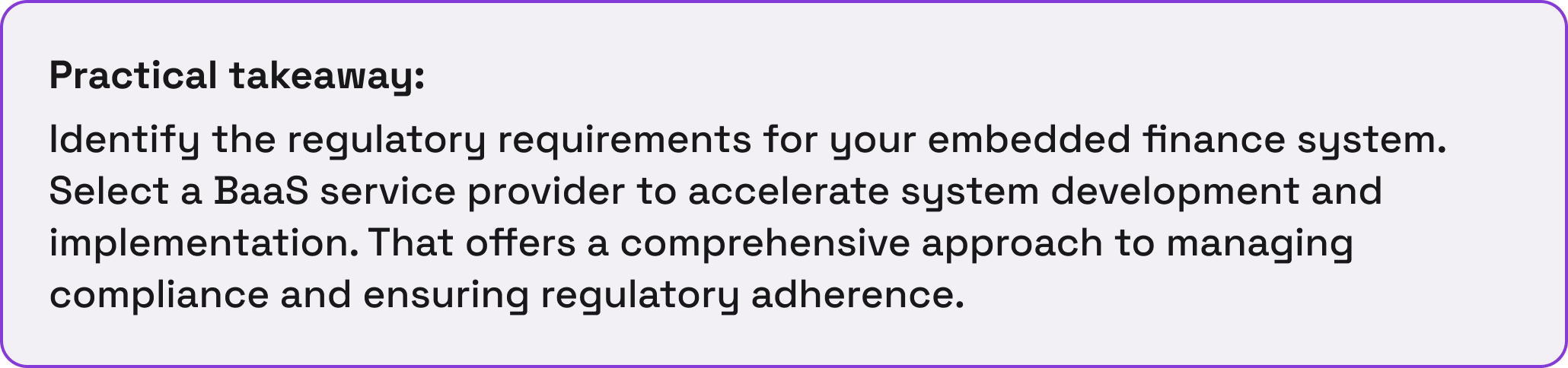
You must decide whether to develop a financial API in-house or invest in a BaaS (Banking as a Service) provider. Without the right resources, building takes a long time and requires significant capital investment. It also exposes your company to various compliance challenges, compromised system development cycles, and essential technical debt.
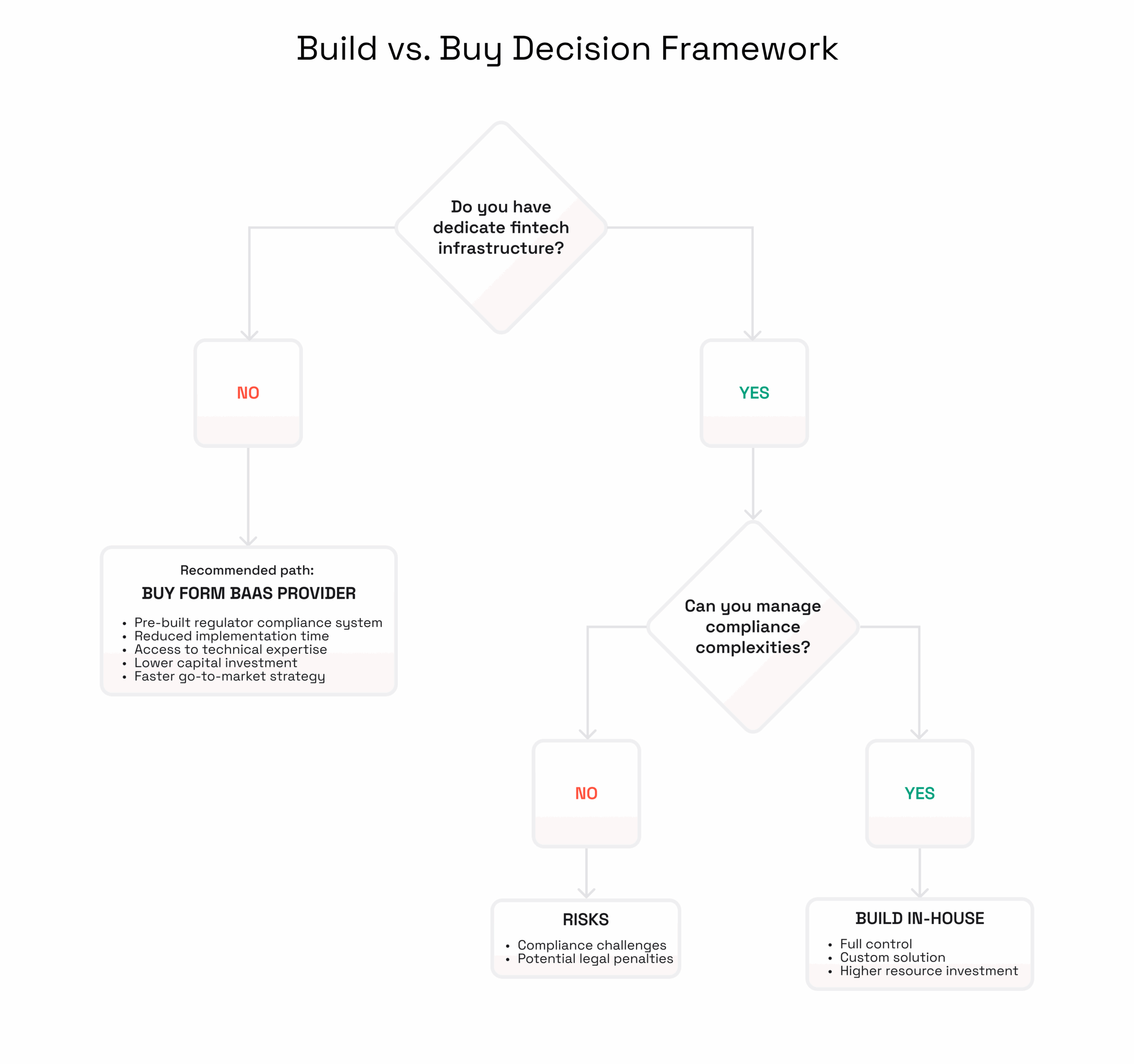
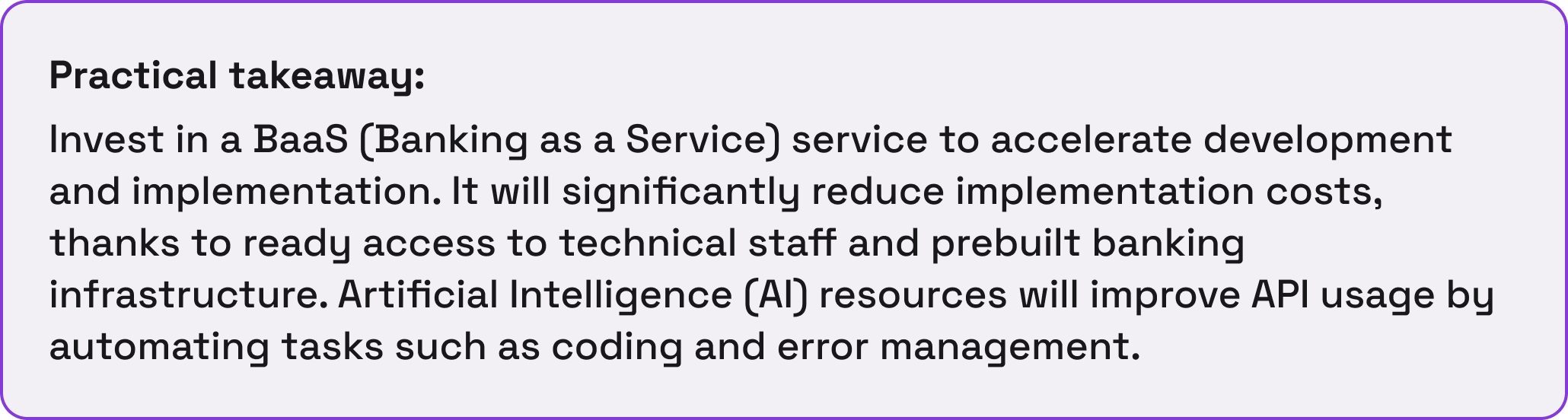
Partnering with an advanced Banking as a Service (BaaS) provider offers a strategic approach to mitigating technological complexity, compliance challenges, and implementation risks. These services feature prebuilt, regulatory-compliant embedded finance systems. Doing this significantly reduces the time required for system development and implementation.
The decision criteria for investing in such a service are time, capital, and your staff's ability. For most businesses, the buy option is ideal as it offers more time to focus on other equally critical financial procedures.
Building is only applicable if your firm is large and already has the dedicated fintech infrastructure required for such processes.
Navigating Compliance and Risk Management in Embedded Finance
Comprehensive compliance represents a critical strategic imperative in embedded finance implementation, requiring multi-layered risk management and regulatory adherence. It ensures consumers have access to secure, legally approved resources. Examples of compliance regulations in embedded systems include Anti-Money Laundering (AML) and General Data Protection Regulation (GDPR).
Compliance also includes PCI-DSS (Payment Card Industry Data Security Standard), which ensures customer data is protected from unauthorized access. Your business must also comply with PSD2 (Payment Services Directive 2), which supports open banking and secure user authentication procedures. Furthermore, data residency compliance laws are crucial because they dictate the mechanisms for storing customer data.
These compliance and data management laws vary based on factors like location, product offerings, or services. Firms that fail to comply face punitive measures, typically fines.
For this reason, compliance has become one of the top challenges in the embedded finance sector. Partnering with services like Staq.io will solve this problem, as they handle compliance across different regions and securely manage API data.
Remember to keep up with any changes to compliance regulations relevant to your embedded payment systems.
Implementing Technical Infrastructure for Embedded Finance
Implementing an embedded financial system requires specialized technical resources and a comprehensive strategy. First, you need trained staff who will handle API development and integration.
You also need product managers who will map out system features and the compliance or automation procedures. Remember to budget for setup and ongoing maintenance of the financial system.
Determine whether your in-house team will handle the financial fintech infrastructure development. A BaaS platform is better because it provides custom, iterative, and fast solutions.
Remember to set aside a customer support team to handle any challenges or bugs that arise during system use. Release your embedded finance implementation as a pilot project first, targeting a specific number of users or a specific demographic for feedback.

Launching Embedded Financial Solutions Strategically
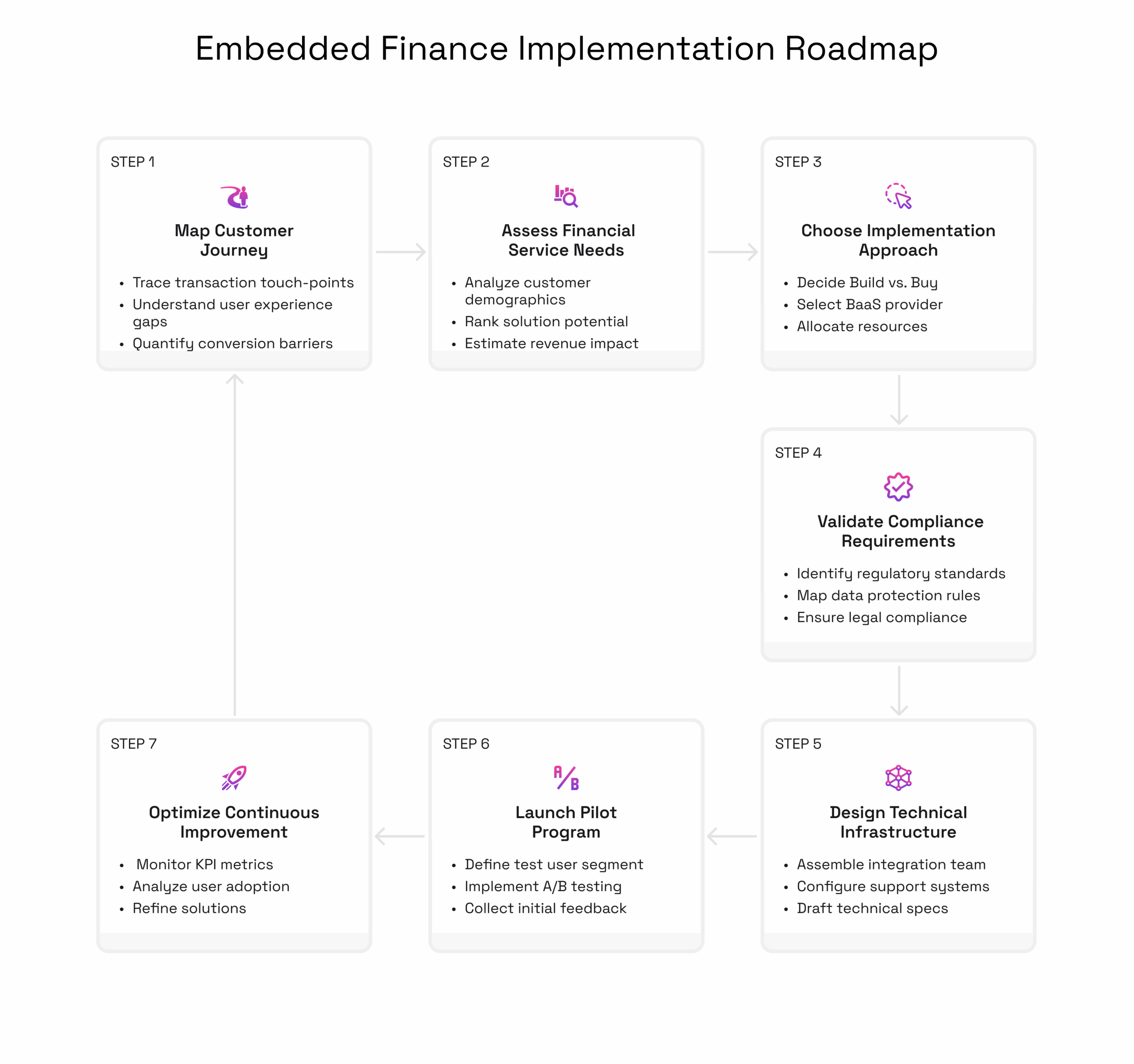
Once your strategy is ready, here is a step-by-step framework for launch:
- Discovery: Map your customer's shopping journey. Track the challenge points and identify your business's needs.
- Scoping: Identify the relevant embedded finance solutions you must implement. Rank them based on customer demand and potential revenue.
- Compliance: Identify all regulatory requirements relevant to your system's operations. Please share them with your preferred BaaS before system development.
- Integration: Assign trained and technical staff for this process. Also set up customer support teams to track any usability challenges.
- Launch: Roll out the system to a select number of users, including some customers. Monitor system usage and adoption rates.
- Iterate: Track KPIs and conduct extensive system testing.

Measuring Success and Iterating
While embedded finance systems are beneficial, using them correctly requires data-driven iteration. You must track Key Performance Indicator (KPI) metrics that are relevant to the system's performance.
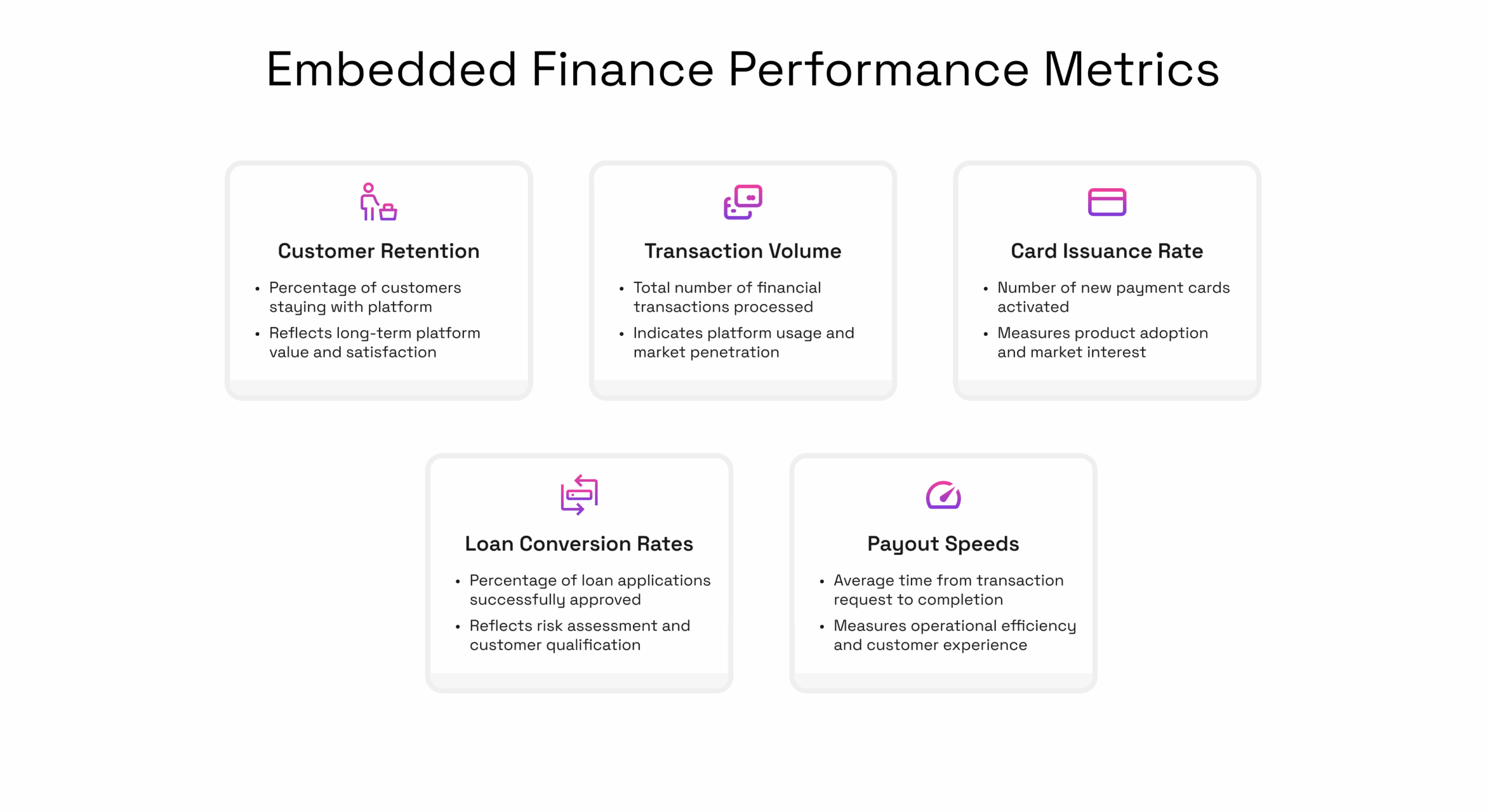
Key Performance Indicators (KPIs) for embedded finance solutions encompass comprehensive metrics including user adoption velocity, revenue optimization, transactional efficiency, and strategic integration effectiveness. Businesses that integrate embedded systems experience a 20%+ increase in customer retention [4].
The ideal measurement framework involves evaluating the system's performance. Evaluate the metrics that are relevant to the financial solutions you have offered. For instance, the transaction volume or card issuance rate in your service over time. Measuring success for your business will also involve loan conversion rates and payout speeds.
Implement a feedback resource to inform the iteration procedures. Your technical staff must also conduct A/B testing to ensure systems deliver value when required.

Transforming Business Growth with Embedded Finance
Embedded finance is not just a convenience, it’s a strategic growth lever and a competitive moat. Businesses that implement embedded finance solutions experience advantages in revenue, customer retention, and conversion rates. By integrating services such as instant payouts, buy now, pay later options, insurance APIs, and loyalty programs, companies will streamline customer experiences while developing new revenue streams.
The key to success lies in execution: prioritizing the right services, adhering to compliance, leveraging expert technical resources, and continuously measuring KPIs. When done effectively, embedded finance transforms your operations from transactional to strategic, turning payments and financial services into tools for growth.
When done correctly, embedded finance enables a company to become a well-established service provider. Partnering with a proven service like Staq.io is an excellent starting point.
Ready to empower your business with proven solutions that deliver measurable growth? Request a demo today.